 Tram cong nghe AI
Gemini 4 Argon is Google’s most capable AI model, announced on September 30, 2026, and generally available to paying users since October 13. According to independent testing by Artificial Analysis, it matches GPT-6 Astra in overall intelligence and has the lowest hallucination rate among leading models. It can also write up to 1 million output tokens in a single response.
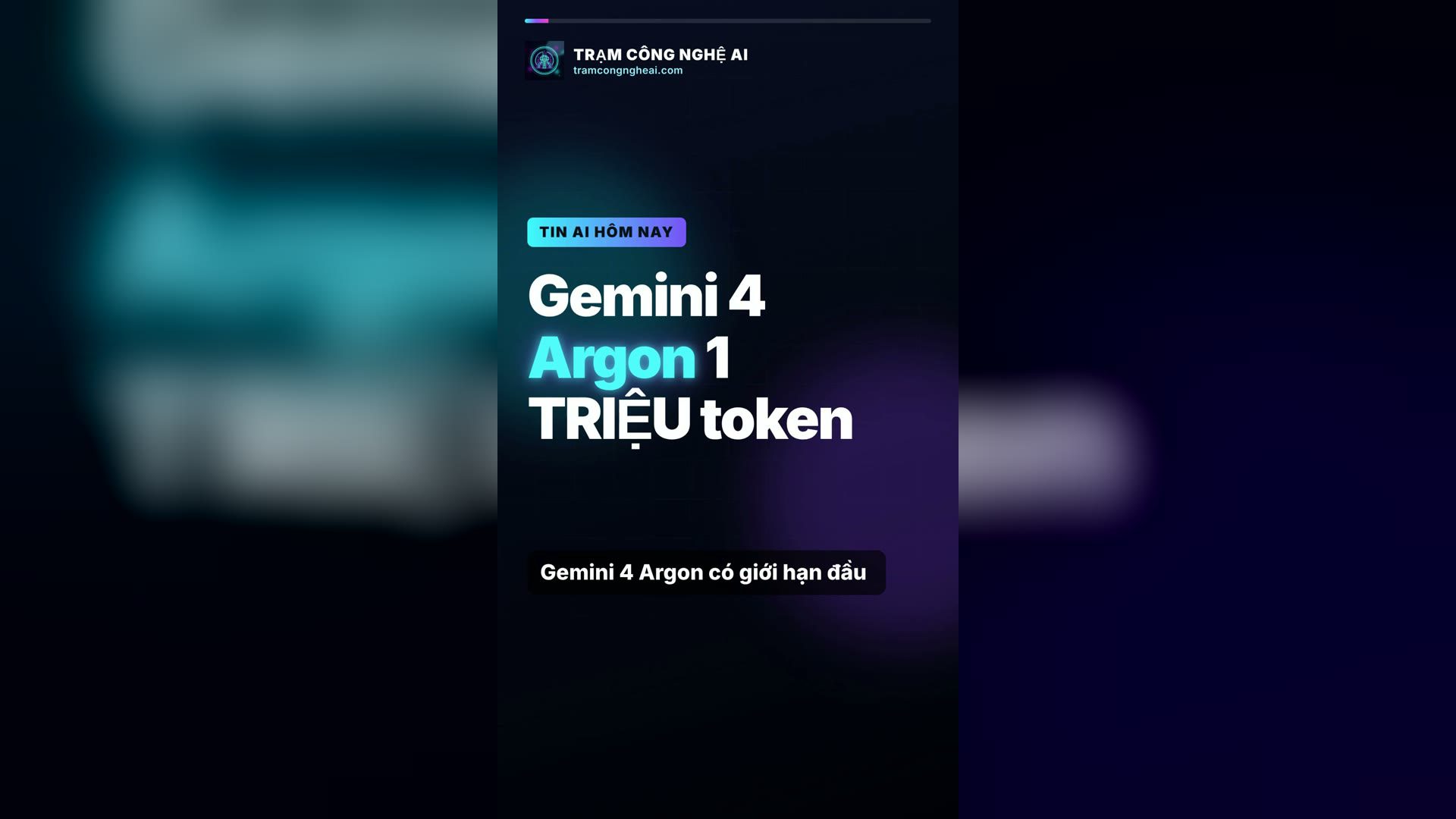
This guide is based on Google’s announcement, Artificial Analysis testing, and reporting by 9to5Google and Technology.org. We have not run our own benchmarks.
Key Takeaways
- Released: announced September 30, 2026, by Google DeepMind; open to paid API users and Google AI Pro subscribers since October 13.
- Intelligence: scores 53 on the Artificial Analysis Intelligence Index, tied with GPT-6 Astra.
- Hallucinations: 15%, the lowest of any model scoring 45 or higher.
- Output limit: up to 1 million tokens, up from 64K in the previous generation.
- Proven at Google: freed more than 300 TiB of data center memory and is rewriting C/C++ code into Rust.
- Price: $2/$10 per million input/output tokens until November 30, then $4/$20. Full breakdown in our Gemini 4 Argon pricing guide.
Watch: our 30-second video summary (in Vietnamese).
What Is Gemini 4 Argon?
Gemini 4 Argon is Google’s new frontier model, built for deep reasoning across long, multi-step workflows. Google’s release notes call it “our most capable model built for complex coding, agentic, math, and science tasks.” Google highlights four core strengths:
- Real-world software engineering, including large codebase migrations.
- Enterprise knowledge work such as finance, legal, and tax.
- Cybersecurity defense: finding, validating, and patching software vulnerabilities on its own.
- Creative writing.
Argon follows Google’s cancellation of Gemini 3.5 Pro and debuts a new naming scheme. It is Google DeepMind’s first proprietary model above the Flash class in more than seven months. What ties its strengths together is endurance: it is designed to keep reasoning through long tasks instead of answering one quick question at a time.
Gemini 4 Argon Benchmarks
Tied With GPT-6 Astra on Intelligence
On the Artificial Analysis Intelligence Index, the model scores 53 with high reasoning:
| Model | Intelligence Index |
|---|---|
| Gemini 4 Argon (high) | 53 |
| GPT-6 Astra (max) | 53 |
| GPT-6.1 Sol (max) | 52 |
| Gemini 3.8 Flash (high) | 41 |
| Gemini 3.1 Pro Preview | 30 |
That is a 23-point jump over Google’s previous Pro model, which puts Google back among the top three AI labs.
The Lowest Hallucination Rate Among Leading Models
On the AA-Omniscience benchmark, Argon has a 15% hallucination rate, compared with 51% for GPT-6 Astra and 54% for GPT-6.1 Sol. In practice, it is far more likely to admit when it doesn’t know an answer than to make one up.
The trade-off is accuracy: Argon scores 50% on that benchmark versus 63% for GPT-6 Astra, so their overall Omniscience scores end up nearly identical (42 vs. 43).
Coding and Agentic Performance
| Benchmark | Gemini 4 Argon | Best rival |
|---|---|---|
| DeepSWE v1.1 (long-horizon coding) | 77.9% | Claude Opus 5.5: 74.2% |
| AutomationBench-AA | 78% (#1) | Claude Sonnet 5.5: 71% |
| CWE-bench v1 (vulnerability repair) | 68% (tied first) | GPT-6 Astra: 68% |
| Terminal Bench 4 | 57% | Claude Sonnet 5.5: 64% |
| LVBench (long video) | 91.7% | State of the art |
Figures as reported by Google and Artificial Analysis; no other lab has reproduced them yet.
What Can It Do? Real-World Uses at Google
Most AI launches are all benchmarks and promises. Google had already put Argon to work internally before the announcement.
A 1 Million Token Output Limit
The headline feature is the 1M token output limit, an industry-leading jump from 64K. Google says that when the model can “think deeply and generate hundreds of thousands of tokens in a single trajectory,” it can solve hard problems in one go. A new Gemini API feature, Long Decode Continuation, pauses very long responses and resumes them in follow-up calls, so requests do not time out.
Data Center Optimization
A team of Argon-powered agents analyzed fleet-wide profiling data across Google’s data centers and applied memory optimizations on their own. The result: more than 300 TiB of memory freed, with Google estimating 500 TiB to 1 PiB in total savings once fully rolled out.
Rewriting C/C++ Into Memory-Safe Rust
Argon agents are migrating C/C++ code to Rust, from core libraries like re2 and libgav1 up to more than 800,000 lines in the Zircon kernel of Google’s Fuchsia OS. Google says every rewrite goes through automated and manual audits, emulation testing, and code review before production.
For libgav1, Google’s open-source video decoder, Argon replaced 32,000 lines of hand-written SIMD code (low-level code that processes many values at once). The new memory-safe decoder runs 2.7x faster than the previous Rust port, with identical output.
Cybersecurity Defense
Security company Wiz uses Argon in its free Scan for Good program, which protects critical public infrastructure. In an early test, it found a critical vulnerability exposing sensitive personal data in healthcare software used by hospitals worldwide that earlier frontier models had missed. Trusted defenders get a version without cyber guardrails.
Enterprise Knowledge Work
Google says Argon leads the Vals Index, which measures economic impact across finance, coding, legal, and tax work, and posts leading results on Vals Finance Agent v2 and Harvey’s Legal Agent Benchmark. It is especially strong at analyzing charts, long videos, and series of documents.
Key Specs and Safeguards
- Context window: 1 million tokens.
- Max output: 1 million tokens.
- Input: text, images, video, and speech. Output: text.
- Model ID:
gemini-4-argonon the Gemini API.
Google is releasing the model with safeguards in four areas: misuse prevention (refusing help with cyber or CBRN attacks), prompt injection defense (Google says it leads Gray Swan’s Indirect Prompt Injection benchmark), misalignment monitoring, and hardened sandboxes for high-risk testing.
How to Access Gemini 4 Argon
Google first limited Argon to trusted cyber defenders in its Fairwind Program, its own staff, and the US government. Since October 13, 2026, it is open more widely:
| Where | Who gets Argon |
|---|---|
| Gemini API | Paid tier only, model ID gemini-4-argon |
| Google AI Studio | Paid API key required |
| Gemini app and AI Mode in Search | Google AI Pro subscribers ($19.99/month) |
| Antigravity (Google’s agentic coding platform) | AI Ultra subscribers ($99.99/month) and eligible enterprise users |
| Free tier | No access |
What you should do: test it on long tasks such as large refactors, migrations, and deep research, not quick chat prompts. If you use the API, try it before December 1, when rates double. See the full Gemini 4 Argon pricing breakdown to estimate your real cost.
Is It Worth Using?
Yes, for long, multi-step work where mistakes are costly: document analysis, large coding projects, and research. Its 15% hallucination rate is its biggest differentiator. A model that says “I don’t know” is easier to trust than one that answers confidently but wrongly.
The main caveat is cost. Artificial Analysis found that Argon averages 62,000 output tokens per task, more than twice GPT-6 Astra’s 27,000. At the launch price it costs about $1.99 per task on their suite, 60% of GPT-6 Astra’s $3.26. At the standard price, that rises to about $3.98, roughly 1.2x more than GPT-6 Astra.
Our take: the most convincing thing about Gemini 4 Argon is not a benchmark. It is that Google already trusts it with production-scale engineering work. If your work involves long, complex tasks, it is the Gemini model to test now, while the launch price lasts.
If you want to see how Google is turning its models into agents, read our guides to the Gemini agent for work and Gemini Spark.
Gemini 4 Argon FAQ
When was Gemini 4 Argon released?
Google announced it on September 30, 2026, and made it generally available on the paid Gemini API and to Google AI Pro subscribers on October 13, 2026.
Is Gemini 4 Argon better than GPT-6 Astra?
They are tied on overall intelligence (53 points each). Argon leads on hallucination rate and some coding benchmarks, while GPT-6 Astra has higher knowledge accuracy.
What is Gemini 4 Argon’s output limit?
Up to 1 million tokens per response, up from 64K in the previous generation. Its context window is also 1 million tokens.
Is Gemini 4 Argon free?
No. The free tier of the Gemini API gets no access. Consumers need a Google AI Pro subscription to use it in the Gemini app.
Did Gemini 4 Argon replace Gemini 3.5 Pro?
Gemini 3.5 Pro was cancelled before release. Argon is Google’s new top-tier model following that decision.
Sources
- Google Blog: Gemini 4 Argon: our next era of frontier intelligence
- Artificial Analysis: Gemini 4 Argon: Google is back as one of the top three labs
- 9to5Google: Google announces Gemini 4 Argon
- Technology.org: Google Opens Gemini 4 Argon at $2/$10 Pricing
Last updated: October 30, 2026